The Safety Show
A devised performance using shared augmented reality to make invisible fears, memories, and experiences of safety spatially visible around live actors.
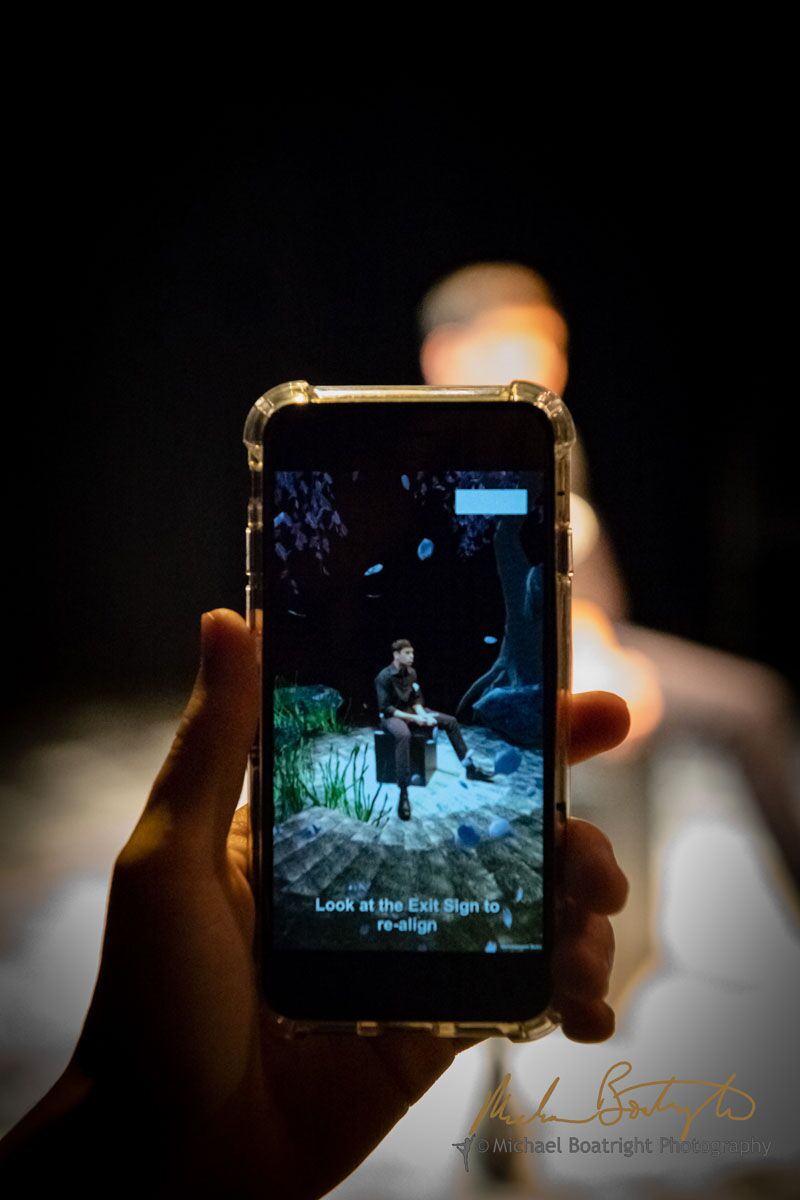
How can augmented reality make invisible fears and traumas perceptible within live performance?
The Safety Show grew from the same research trajectory as my dissertation but was a distinct practice-based design project. Six student performers devised autobiographical stories about safety, loss, identity, mental health, empowerment, religion, friendship, and the campus context surrounding the death of Scout Schultz. XR became scenography for experiences that could not be represented through conventional set pieces alone.
Designing a networked XR layer that could respond to live actors, stage management, and a moving audience.
I collaborated on the production as an XR designer and developer. My work included the shared AR system, interaction and scenographic design, motion-capture integration, multi-device networking, and the technical workflow connecting a stage-management application to audience devices.
My role
XR Collaborator · Designer · Developer. I designed and developed the computational layer of the performance in collaboration with director Melissa Foulger, the ensemble, Jennifer Edwards, DramaTech, and Arts@Tech.
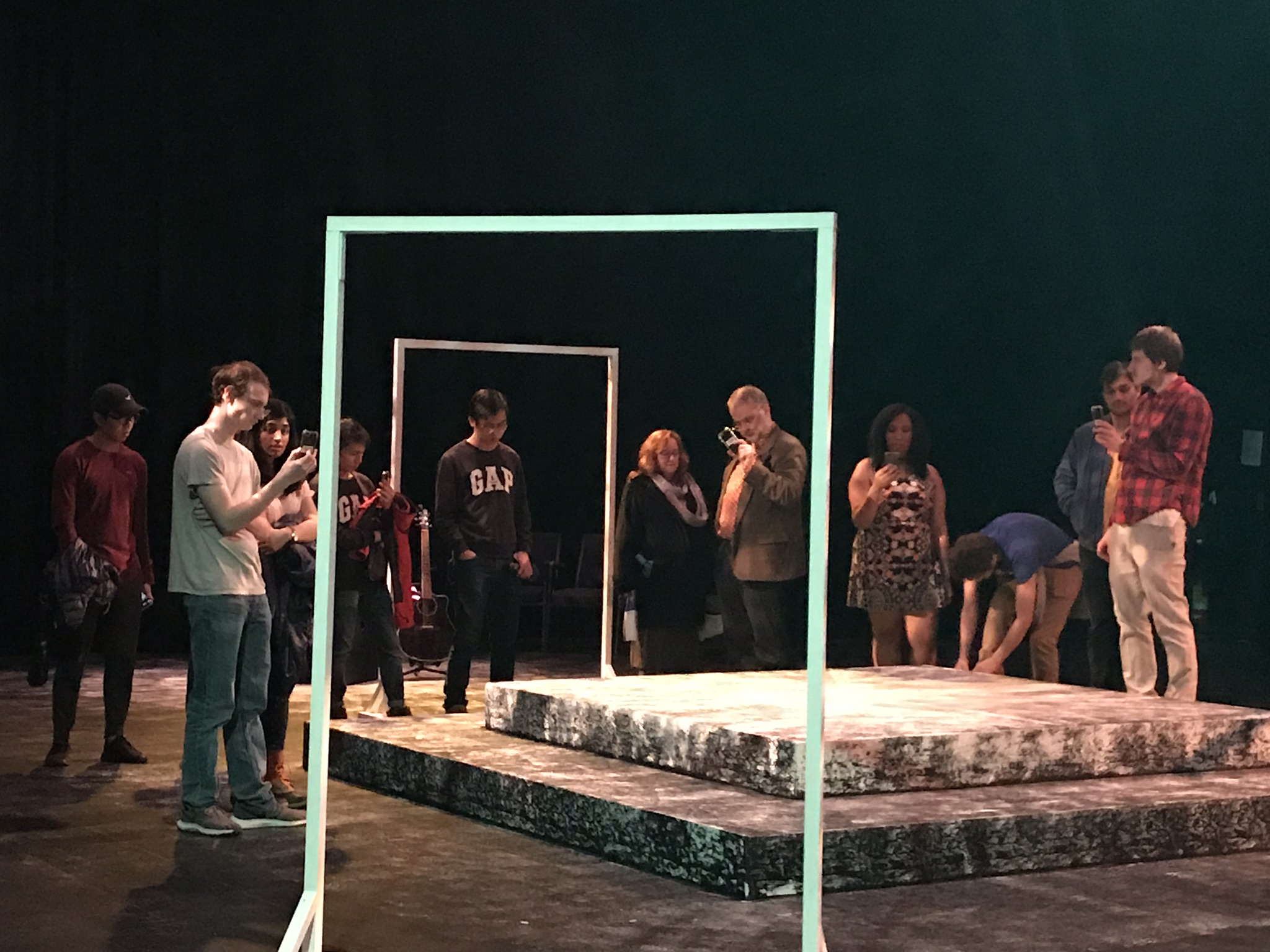
Twenty networked phones turned the audience into mobile viewers of a shared but otherwise invisible stage layer.
Two applications were synchronized over Photon networking: an audience application that acted as a window onto the XR layer, and a stage-management application used to cue digital scenes in time with live performance. Actors rehearsed gestures against digital material they could not directly see, learning to bridge their bodies, physical scenery, and the audience’s mediated view.
The design was intentionally relational. XR was meant to create tension with bodies and physical space rather than function as a detached screen-based effect.
Digital scenography gave spatial form to memory, grief, and autobiographical experience.
In one scene, physical platforms became an XR forest of trees, rocks, clouds, and animated birds while an actor told a personal story. In another, cherry-blossom petals fell as a performer described his grandfather’s death, creating a shared visual gesture around grief. Motion-captured performers were rendered with a ghost-like shader when realistic avatars produced an uncanny mismatch with the biographical monologues.
These moments show the project’s underlying proposition: the computational layer was most effective when it clarified or intensified an embodied story rather than competing with it.
The run exposed both the expressive potential and the infrastructural difficulty of multi-user XR performance.
The February 2019 run at DramaTech documented 78 attendees, 20 rented iPhone 7 devices, and a production involving 34 students. The project did not use a formal audience experiment; instead, the published research reports design insights from rehearsals, deployment, technical failures, stage-management practice, and observation across the production.
The theater became a stress test for computational systems under live, social conditions.
The project surfaced practical constraints that are easy to miss in isolated demos: changing theatrical lighting destabilized tracking; human bodies and a packed room affected Wi-Fi; mobile-device memory constrained model complexity; device distribution and charging became part of the performance system; and one stage manager could not reliably manage both XR cues and audience support without additional crew.
The strongest insight was not that XR automatically improves theater. It was that successful XR performance requires the technical system to remain subordinate and responsive to live bodies, spatial conditions, audience movement, and the improvisational logic of performance.
Georgia Tech documented the production and its shared XR interaction model.
Practice-based design insights were published after the production.
A collaborative theatrical production with distinct creative and technical authorship.
XR research/design/development: Joshua A. Fisher.
Direction and devising: Melissa Foulger and the ensemble.
Community/artistic context: Jennifer Edwards’s I Feel Safe When project, DramaTech, Georgia Tech Arts@Tech, performers, designers, and production crew.